

Why Your AI Content Ranks on Page 5 (And How to Fix It)
86.5% of top-ranking pages use AI, yet most AI content never ranks. Here's why AI content fails and the specific fixes that actually work.
Antislop Team
AntiSlop

Quick verdict: AI content ranks when it is edited into something search engines can trust and readers can use. The fastest fix is not "use less AI." It is adding first-hand examples, stronger internal links, visible sourcing, and a clearer answer to the exact query your reader searched.
TL;DR: If your AI content ranks on page 5, fix these four things first: tighten the first screen around the exact query, add one real example plus one cited source, route internal links from related posts, and answer the reader's next obvious question before they bounce.
Jump to what you need: 72-hour rescue plan · Start-here diagnosis · Four critical failures · Specific fixes that move the needle · FAQ
You've published thirty AI-generated articles this month. Your content calendar is full. Your blog looks active. Yet when you check Google Search Console, the average position hovers stubbornly between 45 and 65. Page five. Maybe page six on a good day.
The uncomfortable truth: AI content tools have made it ridiculously easy to produce articles, but they haven't solved the harder problem of making those articles rank. The gap between "published" and "performing" has never been wider, and most content teams are stuck in it right now.
Here's what the data actually shows. Ahrefs analyzed 600,000 pages across 100,000 keywords and found that 86.5% of top-ranking pages contain some AI-generated content. But here's the critical detail: only 4.6% of those pages were pure AI. The vast majority—81.9%—were hybrid content combining AI assistance with substantial human input. Google's own people-first content guidance says its systems prioritize helpful, reliable content created for people rather than pages produced to manipulate rankings.
The correlation between AI content percentage and search ranking? 0.011. Effectively zero. Google doesn't penalize AI content. It simply doesn't reward content that lacks the signals it's looking for—regardless of how it was produced.
This article isn't about abandoning AI. It's about understanding why most AI content fails to rank and implementing the specific fixes that separate the 4.6% that ranks from the 95.4% that doesn't.
The 72-hour rescue plan for AI content stuck on page 5
If your AI content ranks on page 5, start here
If you want the short version: page-five AI content usually has a packaging problem, an evidence problem, or a site-architecture problem. Fix those in that order before you spend another week generating more drafts.
The Four Critical Failures of Unranked AI Content
When AI content doesn't rank, it usually fails in one of four specific ways. Understanding these failure modes is the first step toward fixing them.
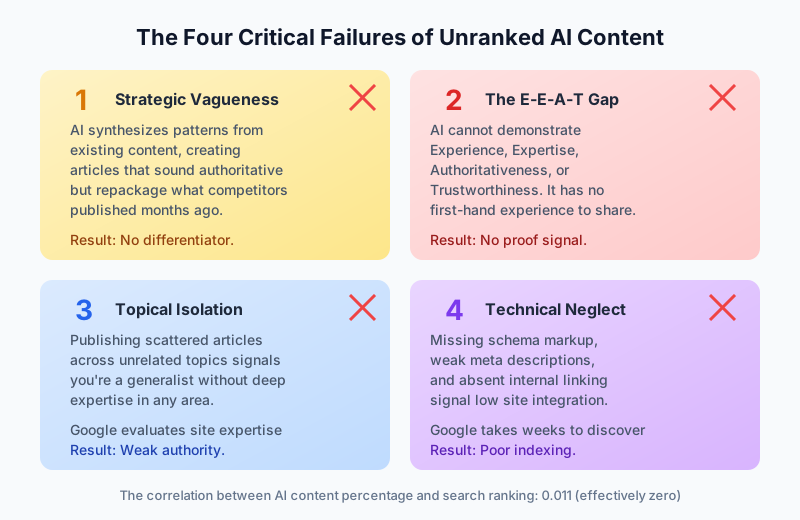
The critical insight: 86.5% of top-ranking pages contain some AI content, but only 4.6% are pure AI. The 81.9% majority are hybrid content combining AI assistance with substantial human expertise, examples, and site integration.
Failure #1: Strategic Vagueness
AI language models are trained on existing internet content. When you prompt an AI to write about "email marketing best practices," it synthesizes patterns from thousands of existing articles. The result sounds authoritative but essentially repackages information your competitors published months ago.
Google's helpful content system specifically evaluates whether content demonstrates first-hand experience and provides insights readers can't easily find elsewhere. When your article covers the exact same points as fifty others—segment your list, write compelling subject lines, test send times—Google has no reason to prioritize your version.
You can spot strategic vagueness easily. The article includes all the right keywords and covers expected subtopics. But when you finish reading, you haven't learned anything actionable. The advice is generic enough to apply to almost any situation, which means it's specific enough to help with none of them.
Failure #2: The E-E-A-T Gap
Google's quality evaluation framework—Experience, Expertise, Authoritativeness, and Trustworthiness—represents the most significant challenge for pure AI content. These signals require elements AI cannot produce without human direction.
Experience is the obvious gap. An article about project management software should demonstrate the author has actually used these tools in real work environments, not just read about them. AI has no personal experience. It can describe features based on training data, but it cannot tell you which tool worked best for coordinating a remote team across five time zones, or why a specific Slack integration solved a workflow problem.
"AI has no personal experience. It can describe features based on training data, but it cannot tell you which tool worked best for coordinating a remote team across five time zones."
Expertise shows up differently but matters equally. AI produces content at a surface level because it's averaging patterns across training data. It misses industry nuance, emerging best practices, and the technical detail that separates expert content from amateur summaries.
Consider conversion rate optimization. AI can explain A/B testing and list common elements to test. An expert can explain why testing headline variations before button colors violates statistical significance principles with limited traffic, or how to structure multivariate tests to isolate design impact. That precision requires genuine expertise.
Failure #3: Topical Isolation
Google doesn't evaluate individual articles in isolation—it assesses your site's overall expertise on a topic based on depth and breadth of coverage. Publishing scattered AI articles across unrelated topics signals you're a generalist without deep expertise in any area.
Many teams using AI fall into the quantity trap. They publish fifty articles across fifty topics, wondering why none gain traction. Meanwhile, competitors publish fifteen articles forming a cohesive knowledge base on three related topics and dominate those search results.
Failure #4: Technical Neglect
Even genuinely valuable AI content can fail due to technical SEO gaps. Indexing problems hit AI content particularly hard—when you publish at high volume, Google may take weeks to discover and process new articles. Every day your content sits undiscovered, you lose freshness signals and competitive timing advantages.
On-page optimization gaps compound the problem. AI tools often generate content without proper technical structure. Missing schema markup, weak meta descriptions, and absent internal linking all signal low integration with your site's content architecture.
What this means if your AI content ranks on page 5
What Google Actually Rewards in 2026
Understanding what doesn't work is only half the battle. Here's what Google's algorithms actually prioritize—and how to build it into your AI content workflow.
Clear Answers to Specific User Intent
Your content needs to directly address why people are searching and provide comprehensive solutions. This means going beyond surface-level coverage to answer follow-up questions, address edge cases, and provide implementation details readers actually need.
When someone searches "how to reduce email bounce rate," they don't want a generic explanation of what bounce rate is. They want specific tactics: how to clean their list, which verification tools work best, how to handle soft bounces versus hard bounces, and what bounce rate thresholds should trigger concern. The content that ranks provides this depth.
Demonstrable First-Hand Experience
Google's quality raters specifically look for evidence that authors have first-hand experience with topics. This doesn't mean every article needs a personal anecdote. It means content should include specific examples, implementation details, and lessons learned that only come from actual practice.
Effective approaches include:
- Specific case studies with real results: Not "a company increased conversions by 50%," but "Shopify store MerchFlow increased checkout completion from 34% to 51% over six weeks by implementing these specific changes to their mobile flow."
- Detailed implementation guidance: Step-by-step instructions that include the specific decisions and trade-offs practitioners face, not just high-level overviews.
- Failure analysis: Discussion of what doesn't work and why, based on actual attempts rather than theoretical predictions.
The specificity test: If you can swap your example with "a company increased conversions significantly" and lose nothing, you haven't added specificity yet. The content that ranks names names and cites numbers.
Topical Authority Signals
Build content clusters around core themes rather than scattering across unrelated topics. A comprehensive guide to email marketing supported by detailed articles on deliverability, segmentation, automation, and analytics signals deep expertise. Fifteen interconnected articles on one topic outrank fifty isolated posts on fifty topics.
Internal linking architecture matters here. Strategic links between related content distribute page authority and help Google understand topical relationships. Your AI content should never publish in isolation—it should connect to your existing content ecosystem.
Technical Excellence
Fast indexing, proper schema markup, mobile optimization, and strategic internal linking create the foundation that allows quality content to compete. These aren't afterthoughts—they're essential infrastructure that determines whether your content gets a fair shot at ranking.
Building an AI Content System That Produces Rankings
The solution isn't abandoning AI. It's building a systematic approach that combines AI efficiency with human strategic direction. Here's a practical framework.

Phase 1: Strategic Pre-Production
Most teams skip this entirely, jumping straight to prompting AI about target keywords. This produces content that's technically complete but strategically weak.
Analyze current search results for your target keywords before creating content. What format dominates page one—comprehensive guides, comparison articles, how-to tutorials? What specific questions do top-ranking articles cover? What gaps exist in current coverage?
Map content clusters around core themes rather than isolated keywords. Identify pillar topics where you can demonstrate expertise, then plan supporting content that links together coherently.
Develop detailed briefs that specify angle, unique value proposition, target word count, required examples, and internal linking targets. The more direction you provide upfront, the less cleanup required later.
Phase 2: AI-Assisted Drafting
Use AI to handle research and first drafts, but control the process tightly:
Feed AI specific context. Don't ask for "an article about content marketing." Provide your target audience, the specific problem they face, the unique angle you're taking, and examples of the depth you expect.
Request structured outputs. Ask AI to organize content with clear headings, bullet points for complex explanations, and specific formatting that matches what ranks for your target keywords.
Generate multiple angles. Run several variations of your core prompt to identify the strongest approach before committing to full development.
Phase 3: Human Enhancement
This is where average AI content separates from ranking AI content. The enhancement phase transforms generic drafts into expert content:
Add specific examples and case studies. Replace generic scenarios with real situations from your business or industry. Include actual numbers, timelines, and outcomes.
Inject expert analysis and insights. Explain the "why" behind recommendations. Challenge common assumptions. Provide nuance about when standard advice doesn't apply. These expertise layers cannot come from AI.
Optimize for engagement. Add compelling hooks, smooth transitions, and storytelling elements that make content interesting to read. AI tends toward flat, encyclopedic writing that needs human polish.
Implement technical optimization. Ensure proper heading hierarchy, add relevant internal links, optimize meta data for click-through rates, and implement appropriate schema markup.
Phase 4: Publication and Distribution
Publication isn't the finish line—it's a checkpoint.
Accelerate indexing by submitting URLs through IndexNow, updating XML sitemaps, and adding internal links from high-authority pages. Don't wait for Google to discover your content passively.
Build supporting link architecture that connects related content and establishes topical authority. Each new article should link to existing relevant content and be linked from existing high-authority pages.
Monitor performance systematically. Track indexing status, click-through rates, time on page, and scroll depth. Use this data to identify content that needs enhancement versus content that's working.
The Specific Fixes That Move the Needle
General frameworks help, but specific tactics drive results. Here are the fixes that consistently improve AI content rankings:
Fix #1: Replace Generic Examples
Before: "Many companies have seen success by optimizing their email subject lines."
After: "E-commerce brand Quip increased email open rates from 22% to 34% by A/B testing subject line personalization. Their winning formula: [First Name], your [Product Category] is waiting—plus 5 subject line templates that generated their highest click-through rates."
The second version provides specific, verifiable details that signal genuine experience and add value AI cannot replicate.
Fix #2: Add the "Why" Behind Recommendations
Before: "Send emails on Tuesday mornings for best open rates."
After: "Tuesday mornings typically show 15-20% higher open rates for B2B audiences because inboxes are less crowded after Monday's backlog clears, but before mid-week meeting density peaks. However, this varies significantly by industry—SaaS companies often see better performance on Wednesday afternoons when decision-makers review weekly metrics."
The enhanced version explains the mechanism, acknowledges variation, and demonstrates expertise beyond pattern recognition.
Fix #3: Include Failure Modes and Edge Cases
Before: "Use social proof to increase conversions."
After: "Social proof increases conversions when it's specific and credible, but backfires when it triggers skepticism. A/B tests show generic testimonials ('Great service!') often perform worse than no social proof at all. Effective social proof includes specific outcomes, full names with verifiable identities, and context about how results were achieved."
Acknowledging limitations and edge cases signals genuine expertise and builds trust with readers.
Fix #4: Create Proprietary Frameworks
Document your team's specific approaches to solving common problems. Instead of explaining generic "content marketing best practices," present your "Content Authority Framework" or "Three-Pillar Topic Cluster Method."
Proprietary frameworks:
- Demonstrate genuine expertise and original thinking
- Create content competitors cannot easily replicate
- Provide memorable, shareable concepts that earn backlinks
- Signal authority to Google's quality evaluation systems
If you are also evaluating vendors, compare this framework against our guide to AI content writers in 2026 and then pressure-test the finalists with this AI copywriting tool buyer's guide, especially if your real problem is cleanup debt between draft and publish. And if the ranking issue starts with flat first drafts, use our editor's checklist on how to humanize AI content to tighten the output before it goes live. If the real upstream issue is sameness before SEO even starts, map that failure against why AI content sounds generic, run the 15-minute triage in why AI content sounds the same, and rebuild the brief with content briefs for AI writers before you publish another draft.
Measuring What Actually Matters
Rankings are important, but they're lagging indicators. Track these metrics to optimize your AI content system:
Indexing velocity: How quickly does Google discover and index new content? If articles take weeks to appear in search results, you have technical infrastructure problems to solve.
Click-through rate from search: Are your titles and descriptions compelling enough to earn clicks? Low CTR indicates optimization opportunities even when rankings are decent.
Engagement depth: Time on page and scroll depth reveal whether content satisfies reader intent. Shallow engagement signals content quality issues.
Content efficiency ratio: What percentage of published articles achieve first-page rankings within 90 days? This measures your system's effectiveness, not just output volume.
The Reality Check
Let's be direct: most AI content doesn't rank because most teams use AI as a replacement for strategy, not a tool to execute it. They publish volume instead of value. They optimize for keywords instead of intent. They chase algorithms instead of readers.
The 4.6% of pure AI content that ranks successfully succeeds because it accidentally—or intentionally—includes the signals Google rewards: original insights, demonstrable expertise, comprehensive coverage, and technical excellence. The hybrid content dominating search results succeeds because humans add the expertise layers AI cannot generate.
AI content can absolutely rank. The tool isn't the problem. The workflow is.
Build a system that uses AI for what it does well—research, structure, consistent output—while humans focus on what AI cannot do: adding genuine expertise, unique perspectives, and strategic optimization. Measure results based on ranking performance and engagement depth, not article count.
The teams winning with AI content have figured this out. They're not publishing more content than their competitors. They're publishing better content, more efficiently. That's the gap you need to close.
FAQ: how to make AI content rank instead of stalling on page 5
Does Google penalize AI content?
No. Google's public guidance does not ban AI-written material. What it filters out is low-value content that fails to help the reader. The reason AI content ranks on page 5 is usually not the presence of AI. It is the absence of evidence, experience, and clear intent matching.
Why does AI content rank on page 5 instead of page 1?
Because most teams stop at draft completion. The post gets published before it has enough first-hand examples, internal links, source citations, and query-specific packaging. Page-one content usually answers faster, proves more, and sits inside a stronger topic cluster.
How do you make AI content rank higher?
Start by rewriting the first screen so the exact search intent is answered immediately. Then add one or two real examples, cite primary sources, strengthen internal links from relevant posts, and tighten the title plus meta description around the target keyword. Those changes usually matter more than generating a longer draft.
Is human editing still necessary for AI content SEO?
Yes. The winning pattern in the Ahrefs data is hybrid content, not pure AI. Human editing is where the differentiators show up: original judgment, sharper claims, proof, and site integration. That is the layer search engines and readers both respond to.
Related Articles
The LinkedIn Post Generator Problem Is Voice DNA
Most LinkedIn post generators copy surface tone. The posts that still travel have structure, proof, and a recognizable line of thought.
Pass AI Detection Without Sounding Generic
Passing AI detection is not a synonym game. It starts with evidence, point of view, and a draft that carries a writer’s reasoning pattern.
How to Humanize AI Content: An Editor's Checklist That Actually Works
AI detectors flag 61% of human-written non-native English as AI. Here's a practical editing framework to make AI content sound human.
Ready to kill the slop?
AntiSlop learns your voice and creates content that sounds unmistakably you.
Try AntiSlop free